Thirty Hours in a Storm off the Coast of South Africa
This post was written in English.
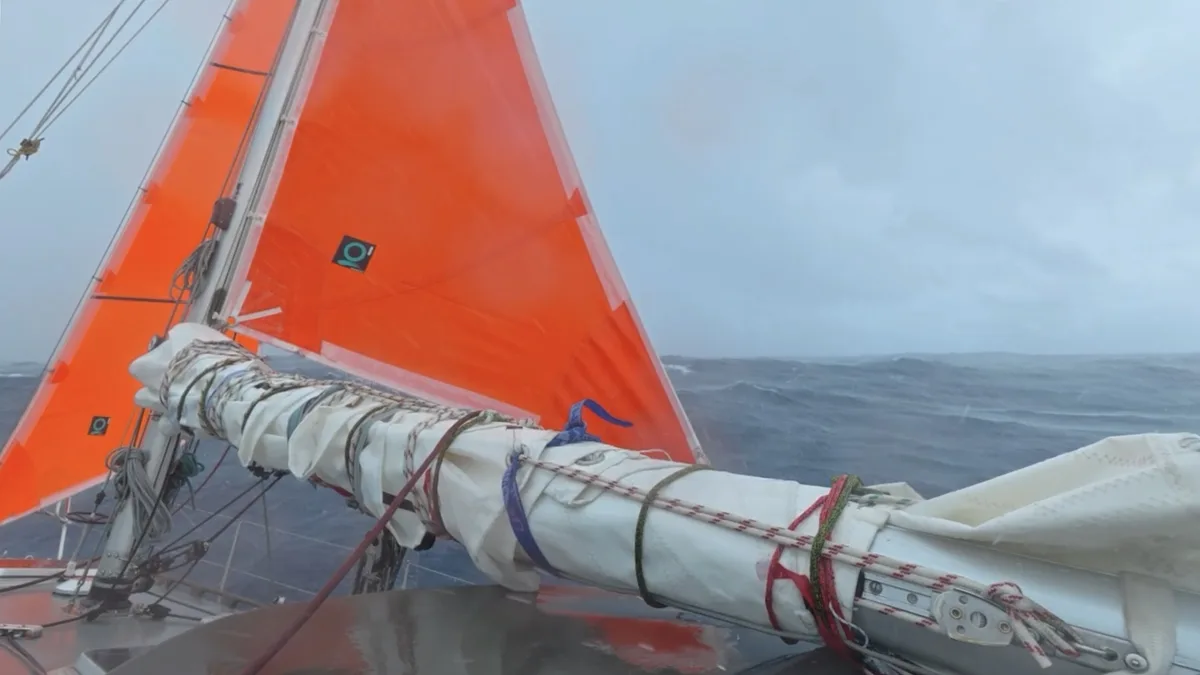
I left La Réunion on the 28th of October for Richards Bay on a beautiful, fast passage, with peaks of 145 and 159 nautical miles in 24 hours. The total distance is 1,550 nautical miles. But the sting was in the tail. I couldn’t avoid the southwesterly storm that was coming. And the front was so wide that I had nowhere to go.
Thirty hours hove-to, 65 nautical miles of drift, and a half-sunken ship drifting towards me. This is how I prepared for and rode out my first real storm on SY Loveworkx, about 185 nautical miles east of Richards Bay.
A front was coming up from the south, bringing wind against the Agulhas Current. If I had sailed on, I would have been right in that current when the wind turned. So I decided to wait it out at sea.
And I wasn’t alone. From all kinds of places around the world, fellow sailors and followers sent me messages to keep my spirits up.
1. Making the plan
First I needed a plan: which sails, and in what order.
I weighed three options: the mainsail with three reefs plus the storm jib, the storm jib alone, or the trysail plus the storm jib. I chose the trysail and the storm jib. They are made for this kind of wind, and my mainsail stays safe on the boom for the rest of the voyage.
The trysail shares the mast track with the mainsail and is hoisted on the main halyard. I had only hoisted and checked it on the hard in Trinidad. So the switch from mainsail to trysail held the most complexity and uncertainty, and I did that first:
- Mainsail down, slides out of the track, lashed tightly to the boom
- Boom secured so it can’t swing
- Trysail on, sheets led aft to the winches
- High-aspect jib off, storm jib on
All of it in daylight, while it was still calm.
Why heave-to? I can’t sail in winds this strong, and I don’t want to sail on into the Agulhas Current, with all the consequences that brings. When the wind blows against the current there, the waves become short, steep and dangerous. In extreme cases this can produce waves up to 20 metres high.
Hove-to, the boat lies at an angle to the waves, quietly and with little speed, and slowly drifts away from the coast. That spares the boat and me. I can rest, eat and sleep, and let the storm pass.
I worked out two routes to heaving-to.
The first: as soon as the wind drops, I turn the bow east. I back the storm jib to starboard and leave the trysail to port. When the wind comes from the south, I’m lying correctly straight away.
The second: I sail on until the wind has turned, then tack and leave the jib sheet where it is. The jib is then backed automatically.
Which one it would be, I would decide when I saw what the wind was doing.
2. Carrying out the plan
This morning I spent a few hours getting the boat ready for the storm. Finding the right position for the boom took the most time. The sailmaker advised laying the boom on the deck. But on my boat that isn’t practical, because the sheet block and the little block at the end of the boom for the topping lift would take a beating. So everything loose, then fast again. It was a bit of a puzzle.
I also put an Antal hook where the trysail block goes. Ordinary blocks rattle terribly, metal on metal.
Then the high-aspect jib came off and went into its sail bag on the railing. Then I cut the bag loose and pulled the whole sausage inside. I don’t want a sail bag out there catching wind and waves.
Inside it’s getting cosier, since the sail bag is now lying in my bed. As soon as we heave-to on the other tack, I’ll sleep on the other side.
A last job: tying down the solar panels. And then a nap. I’m dead tired but satisfied.
The nerves of this morning settled while I concentrated on each step.
Checking in with Tim
Before going to sleep, I checked in with Tim, my weather router.
Me: Any news on the weather?
Tim: In 5–6 hours the wind will start to build. In 10–11 hours it’ll be at 20 knots and things begin. I now see a maximum of 28 knots, gusts 35, where you’ll be. But locally I can’t rule out something extra. Sunday night into Monday it goes back to 20–25, and on Monday you can carry on with three reefs.
Me: Any thoughts on heaving-to? At what wind speed? Or as soon as the wind has gone south?
Tim: Very hard for me to say… you know your boat. The main decision will be on Monday, when you decide to sail again.
Me: Heaving-to with a trysail is new for me.
Tim: I’ve never done it with your boat either 😇😉
Me: I thought we were in the same boat 🤣
Tim: But it shouldn’t be very different. You may have a little less weather helm.
Me: That’s nicer, right?
Tim: In the end it’s about the balance between heading up into the wind from the main and rudder, and bearing away from the backed jib. With a trysail that balance is different, not necessarily nicer or worse.
Me: So it’ll be a bit of playing around…
Tim: Exactly.
Everything was ready. Now rest, eat, and see what the sea would bring.
3. Testing the plan: heaving-to in time
I sailed west for as long as I could. When it started blowing 24 knots and the wind began to howl, I tacked to heave-to, with a little help from the engine to get the bow through the wind.
I didn’t wait for the peak. I wanted to find out how Loveworkx lies with this sail combination while it was still manageable.
At first she wasn’t really hove-to at all. The bow pointed northeast, apparent wind 85°, boat speed 3 knots: she was still slowly sailing. The tiller couldn’t go any further. Engine off, trysail hauled in, storm jib eased a little. Then she came up to an apparent wind angle of 60°.
My notes from that moment:
I’ve just hove-to. AWA 60. Drifting northeast. Boat speed 1.8–2.7. Position 28°12.662’ S, 035°29.863’ E. COG 50, TWS 22.5. It’s uncomfortable. Exciting. I’m mainly watching the AWA. It’s now between 35 and 55.
Then the wind dropped back to 18 knots and she rounded up to 15°, almost through the wind. I eased the trysail. I wanted to feel that it was going well before I closed myself off from the cockpit completely.
4. The real thing: hove-to through the storm
The first night
Lying ‘stably’ hove-to means, in this case, an AWA of around 40–60.
The boat goes up and down and back and forth a lot in the waves. But when I began to see it stabilising, I went to sleep.
I’m now lying on the low side, on the other settee. Trying to find my place there and come into surrender. I notice that I’m tense. So I listened to a hypnosis sleep programme that I’ve listened to a lot over the years. My body twitches slightly, a sign of the relaxation setting in.
Although I’ve secured everything well, a few halyards still slap against the mast. A constant reminder that there’s a lot of wind. The boat also shudders regularly, as if it’s a dog shaking water out of its coat while trying to walk on uneven ground.
I’ve just woken up. In the end I fell asleep around 03:30. All is well on board.
AWA 50–60°, TWS 23 knots, SOG 2.5–3 knots. Position 28°03.374’ S, 035°43.444’ E. Water temperature 24.4°C. Still around 25 knots of wind here. Overnight I drifted 16 nautical miles to the northeast.
The storm
At the start, Loveworkx dives into the waves a few times and the water comes rolling over the deck towards the stern.
Now and then the navigation system gives up. It seems to have a life of its own.
Very occasionally a wave comes in from the side, or the whole boat slams flat onto the waves. Later, when the wind builds to 40 knots (Force 8), this happens more often.
I lie on the settee on the low side with AirPods in. They dampen the sound a little, so I can relax and fall asleep.
5. Adjusting the jib as the wind increased
On Sunday afternoon the wind built to 30 knots. In the gusts Loveworkx kept rounding up, and then both sails flogged hard. The whole boat shuddered with it.
I went outside for a moment, clipped in, sheltered under the sprayhood, and tightened the storm jib sheet a few centimetres. Now it shudders less.
The backed jib pushes the bow away a little more firmly, so she rounds up less far. Her range became 35–70° apparent instead of 40–90°. At 35° the jib still flogs, but less often. A small adjustment, one thing at a time, and then wait and watch.
A wreck drifting towards me
First I get a message that a ship is unmanned and sinking. It’s on the same latitude, 120 nautical miles east of me.
After some detective work, I find out via the PredictWind tracker that the half-sunken ship and I are drifting towards each other. We are still 66 nautical miles apart.
Wreck of the M/V WEI XIAO TIAN SHI, 8 November, 19:15
- Distance from my position: 66 nautical miles, bearing 070°
- My drift: 2.3 knots towards the northeast (052°)
- Drift of the wreck: 1–3 knots towards the northwest (300–320°)
- Expected encounter: Monday 9 November, between 10:00 and 19:00
- Expected distance when passing (Closest Point of Approach): between 31 and 5 nautical miles
To stay clear, I would get under way towards the southwest before 10:00 on Monday.
The worst is over
It’s now 04:30 on Monday morning. Only a full bilge, the boat moving like a rocking horse, and 25–37 knots of wind (Force 6–8). We’re through it.
Last night, just like always, I slept a few hours at a time. Sometimes it took a while to fall asleep, and I also had deep sleeps. Unfortunately, then the alarm went off, this time to check the distance to the drifting, unmanned wreck.
The liferaft has come loose from its place and is lying in the middle of the cockpit. Luckily I had secured the wooden bench, otherwise it would be overboard now.
I had remembered to tie down the solar panels. But not the Starlink dish. I always switch it off at night, so I get a fright when I want to connect. It turns out the switch on the panel had taken a knock and flipped. Luckily, it still works.
Then I find the Iridium GO! exec has switched off. Trouble with charging. So I reconnect it to the charging cable and it starts charging again.
I checked the engine, emptied the bilges, and pulled the sheets apart through the forehatch. The other sheet had wrapped itself around it, and I’d rather not go on deck yet.
It’s starting to rain. The boat bobs up and down and back and forth. I’d love to turn the boat around, but I’m waiting for the wind and waves to drop a little.
Sailing again
It’s 06:00. After 30 hours hove-to and 65 nautical miles of drift, I’m sailing again! Woohoo! For now still on my storm sails. 250 nautical miles to go to Richards Bay.