The Empty Boat – A Journey Across the Ocean
This post was written in English.
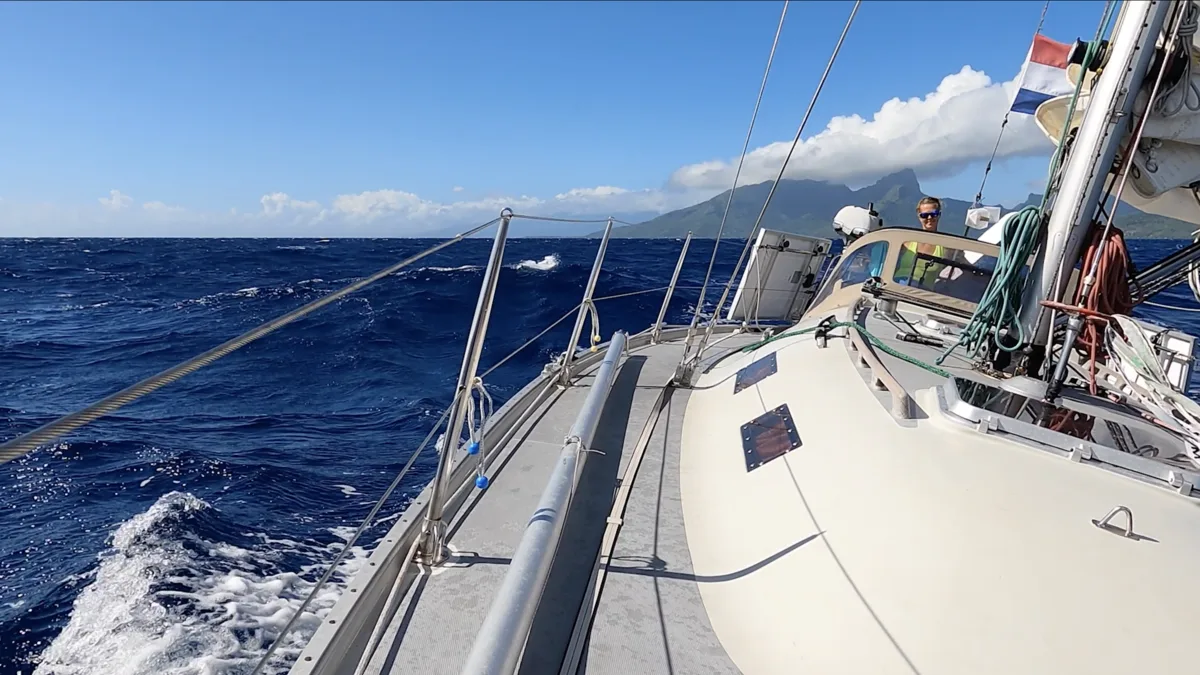
Two journeys in one
When I left the Netherlands in July 2023, I set out on a journey across the oceans. But there was another journey I consciously wanted to explore: creating space to observe life, and myself, more deeply.
I had a sense that living at sea, away from the familiar structures and rhythms of everyday life, would offer a different perspective.
What I couldn’t foresee was the depth of that experience, or how profoundly it would influence my awareness and the way I relate to myself and the world around me.
Meditation and Vipassana were already part of my life before I left. I had completed two Vipassana retreats before departure, and two more during the journey.
The practice of observing thoughts, emotions and sensations without immediately identifying with them was familiar to me. But life at sea offers its own kind of meditation.
Life on a small boat
The vastness of the ocean, the constant need to adapt to changing circumstances, and spending weeks at a time on my own, often without contact with other people, all contribute to an experience that is difficult to compare with life on land.
There are the highs and lows of the weather, with its unpredictable winds and waves. And there are the highs and lows of life on a small boat.
Some days, the boat feels too small, too wet, too hot. Everything is moving, often at a considerable angle, while the boat races over the waves. Even the simplest things become a challenge: brushing my teeth, preparing a meal or going to the toilet.
At times, life is reduced to survival mode, taking care of the absolute basics.
And then there are days when the ocean settles and life slows down. There is time to do a bit of hand washing, take care of myself and wash my hair and simply enjoy the vastness of the ocean around me.
Throughout it all, I remain on watch: monitoring the course, speed, weather and other vessels, while managing with only 30 to 120 minutes of sleep at a time.
And, inevitably, things break and need fixing, sometimes right in the middle of an ocean passage. There is no roadside to pull over and wait for help.
This is on top of the regular demands of sailing. On my boat, every sail change means going forward: reefing the mainsail at the mast, changing headsails on the foredeck, crawling across a heaving deck, holding on and carefully watching every move to avoid going overboard.
Life on board is back to basics. There is no tap to turn on for a shower, no washing machine, all on a boat of eight by three metres.
This constant movement between intensity and ease, vigilance and relaxation, doing and simply being, combined with this simplicity, creates a unique space in which awareness can deepen.
And after three years of living this way, something has changed. I am much more in sync with the movements of nature, and with my own inner nature. There is more calm, a sharper intuition. My feelings lie closer to the surface, and at the same time I am more in the present moment.
When the going gets tough
One afternoon I was kneeling on the hot foredeck, changing the big genoa for a smaller one. One of the hanks jammed on the forestay. I had to make my way back, go below for a pair of pliers, and return to the bow, while it dove into the waves and salt water washed over me.
But the real test came afterwards, when I tried to fold the big sail and could barely get it inside.
That’s when I started swearing into the air. As if I was calling out: is there no one who sees how hard this is for me? Is there no one who can help me?
The empty boat
Today, I read the Taoist parable of the empty boat, in Osho’s book of the same name.
The parable begins with a warning: trying to control others leads to confusion, and being controlled by them leads to sorrow. Yao, the wise ruler, therefore wished for neither.
Then comes the image. A man is rowing across a river when another boat bumps into his.
If that boat is empty, he hardly gets upset, even if he is quick-tempered by nature. But if someone is sitting in it, he yells at them to get out of the way. When there is no response, he yells louder, again and again, until he is cursing.
All because someone is in the boat.
The parable ends with an invitation: if you can empty your own boat as you cross the river of life, nothing and no one will stand against you.
An empty ocean
I recognised myself in that man, with one difference.
He shouted because there was someone in the other boat. I shouted as if there was someone there, while the ocean around me was completely empty.
What I was really missing in that moment was not someone to blame, but someone alongside me. Someone to share it with. That longing is real, and I don’t want to push it away.
But I also noticed how quickly it turned into a story: no one sees how hard this is for me. The longing was human. The story was ego. Within minutes the story was gone. As soon as I realised it, a calm came over me and I continued the task that lay ahead like a meditation.
Who is at the helm?
The parable made me think about the role of the ego in our lives.
How often do we experience the world through the lens of our own identity? How quickly can something become personal? Our opinions, expectations, roles and the image we have of ourselves can subtly influence how we perceive and respond to what happens around us.
Perhaps the invitation of the empty boat is not to get rid of the ego, or to become someone without a personality. I am still Jacqueline: curious, creative, entrepreneurial, decisive and very much engaged in life. I enjoy taking action, making choices, sailing across oceans and discovering new things.
But there is a difference between having an ego and allowing it to lead.
The ego is constantly in motion, steering us all day long. Being at sea, being with the elements, allows it to come to rest. After all, the sea is not trying to make my life difficult. It simply does what it does. Nothing about it is personal.
In that sense, the ocean is the ultimate empty boat.
Emptying my boat
Perhaps an empty boat doesn’t mean having no one on board. It means not having the ego constantly at the helm.
I began this journey around the world by following the call of my soul. It was something very strong from within. It did not come from my head, from a dream I had held for years and was finally fulfilling.
That is why this journey doesn’t feel like an achievement to me, but like an experience.
A unique time to live a completely different life. A life with the seasons, guided by feeling, and in connection.
Not everyone understands this choice. To some, it may look selfish. I can understand that. And still, this was not something I could ignore.
And maybe that is one of the most beautiful things this journey is teaching me: to participate fully in life, without needing to steer it all.
As I write this, I am on my way to South Africa, the most challenging passage of my journey.
I have prepared well, I have alternative options along the way, and I am in close contact with my weather router.
And although there is a good chance I will run into heavy weather towards the end, I keep my attention here and now, and I relax.
I don’t know how this passage will end. And I don’t need to.